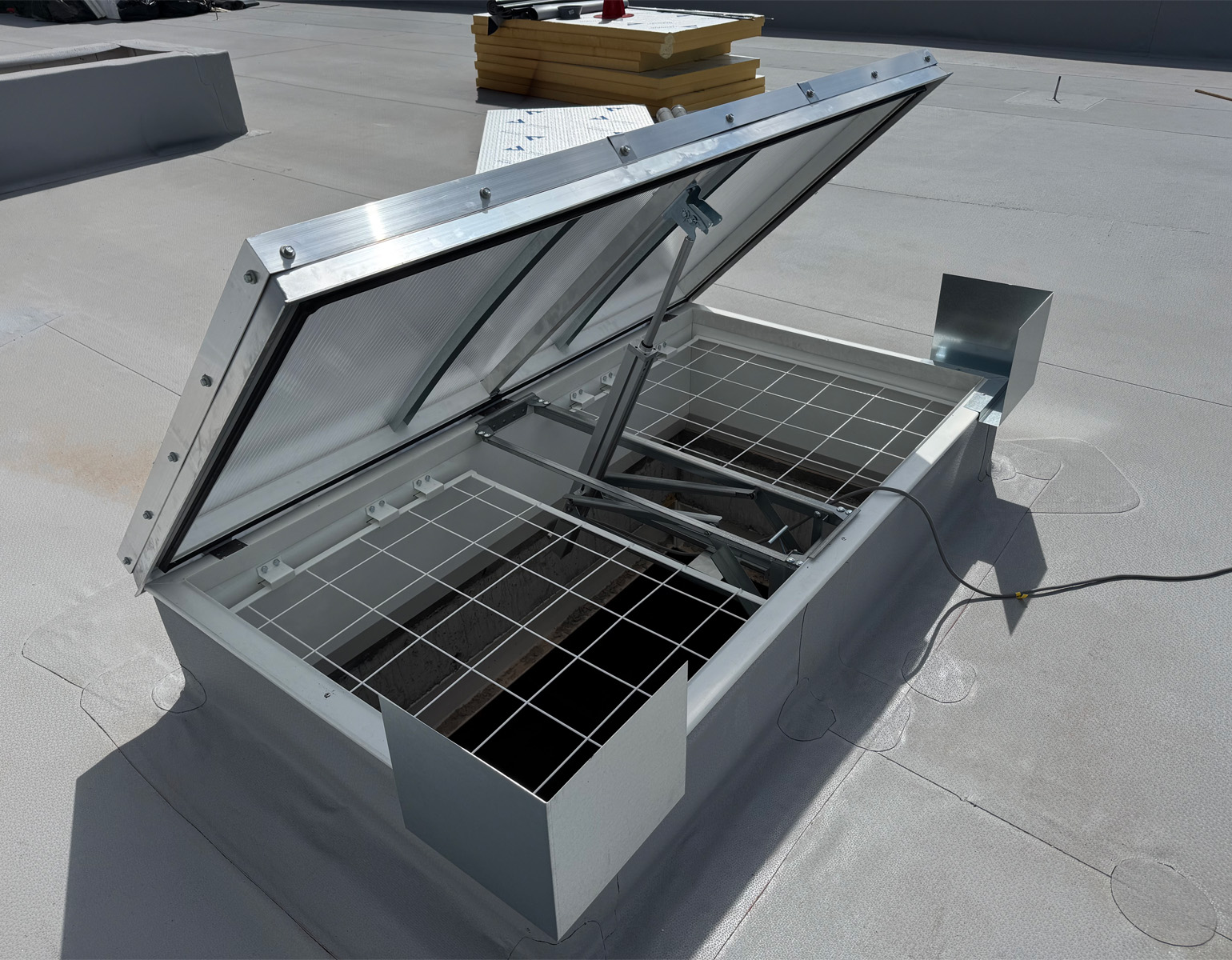
A smoke vent is a device installed on a flat roof that opens automatically in the event of a fire to naturally discharge smoke and hot fire gases out of the building. In the European Union, smoke vents are manufactured in accordance with the EN 12101-2 standard, which specifies, among other things, the required opening time (usually less than 60 seconds from the alarm signal) and snow and wind load resistance classes. Thanks to its transparent or translucent cover, the smoke vent also functions as a skylight, providing natural daylight into the building.


What is the Purpose of a Smoke Vent?
A smoke vent is a component of a natural (gravity) smoke exhaust system, which is an installation that removes smoke and heat from the inside of a building during a fire by utilizing the natural buoyancy of hot gases—without the use of mechanical fans. In industry terminology and European standards, such systems are referred to by the acronym SHEV or NSHEV (Natural Smoke and Heat Exhaust Ventilation), and the vents themselves are sometimes called smoke exhaust vents, smoke dampers, or, in the automatic variant, AOVs (Automatic Opening Vents).
The purpose of a smoke vent is to limit smoke accumulation in the hall at the human evacuation height, facilitate fire brigade access to the source of the fire, and exhaust heat, which slows down the spread of the fire to the roof structure. Due to the cover material (most often transparent or translucent polycarbonate), a smoke vent very often simultaneously functions as a roof skylight, illuminating the hall with natural daylight under normal operating conditions. This combination of functions is eagerly utilized in production halls, warehouses, and logistics centers, where roof lighting reduces the need for artificial lighting during the day.
Smoke vents are installed on flat roofs or roofs with a slight pitch, and they are primarily used in large-area facilities: production halls, logistics centers, warehouses, sports facilities, high-rise buildings, and shopping centers. Essentially, wherever fire safety regulations require a smoke exhaust system due to a large cubic capacity and long evacuation routes.
Working Principle of a Smoke Vent
For the majority of the time, the smoke vent remains closed and tightly sealed. Upon detecting a fire, it automatically opens to the fire position.
The signal to open the vent is generated by the smoke control panel, which receives information from smoke detectors or manual call points distributed throughout the building. Upon receiving the signal, the vent actuator lifts the leaf (or both leaves in the double-leaf variant) to full opening. The open vent creates an opening through which hot fire gases and smoke, being lighter than cool air, rise and escape outside the building under the influence of natural gravity draft (the stack effect)—hence the term "natural smoke exhaust," as opposed to mechanical ventilation, where smoke is actively extracted by fans.
Two types of drives are commonly used to open smoke vents:
electric drive - a low-voltage electric actuator;
pneumatic drive - an actuator utilizing compressed gas (most often CO2 cartridges), valued for its independence from the mains power supply.
The reliability of the opening mechanism is confirmed by tests in accordance with EN 12101-2, described, among others, by the Re class (e.g., Re 1000 means maintaining full operational efficiency after 1000 opening and closing cycles to the fire position).
What Is a Smoke Vent Made Of?
Regardless of the manufacturer, a smoke vent basically consists of three elements: the base (a load-bearing frame mounted on the roof to which the movable leaf is attached), the cover (the light-transmitting movable part—most often made of multi-wall polycarbonate, less frequently of acrylic or glass), and the actuator. The base is usually made of galvanized steel sheet, and its height is selected individually based on the roof structure and the technical requirements of the building.
You can find the full technical specification of smoke vents from the AWAK offer on the product pages: single-leaf smoke vent and double-leaf smoke vent.
Types of Smoke Vents
Smoke vents are primarily divided based on the leaf design into single-leaf and double-leaf vents. An additional division criterion is the shape of the base: straight, straight-slanted, or slanted—selected to match the roof geometry and slopes.
Some smoke vents in our offer also come in a variant that combines the smoke exhaust function with a roof hatch function, enabling safe access to the roof surface. This is a practical combination of two functions in one device that allows for a reduction in the number of separate openings in the roof slope.
Technical parameters and standards
The EN 12101-2 standard introduces a uniform classification of smoke vents for the entire industry, including:
Re - operational reliability measured by the number of opening and closing cycles;
SL - operational reliability under snow load;
WL - resistance to wind load;
B - resistance to high temperatures;
T - the ambient temperature class in which the device can operate.
Where Are Smoke Vents Used?
Due to the requirement for installation on a flat roof, smoke vents are primarily used in large-area facilities:
production halls,
logistics centers and warehouses,
sports facilities,
high-rise buildings,
shopping centers.
In all these cases, the smoke vent plays a dual role: an element of passive fire protection (smoke exhaust) and a source of natural daylighting.
Are a Smoke Vent and a Roof skylight the Same Thing?
A smoke vent and a roof skylight are sometimes confused because both products are installed on a flat roof and both transmit light. However, the difference lies in their primary function: a roof skylight primarily serves to illuminate the room and, in the openable variant, provide daily ventilation, whereas a smoke vent is fundamentally a fire protection device, certified in accordance with EN 12101-2, whose priority function is rapid and reliable opening in an emergency situation. It is the smoke exhaust requirement that dictates the design, materials, and certification method of a smoke vent, even if, in practice, it performs both functions simultaneously.
Smoke Vents In the AWAK Offer
AWAK designs and manufactures smoke vents at its own plant in Buk, as part of the Finnish KERA Group, which is present in 8 European countries. The offer includes single-leaf and double-leaf variants, with straight, straight-slanted, or slanted bases, and selected models additionally feature a roof hatch or ventilation function.
AWAK smoke vents are confirmed by a CE certificate compliant with EN 12101-2:2003, and we provide up to a 10-year warranty on the polycarbonate cover and vent tightness (2–3 years for actuators). AWAK's in-house engineering team supports designers and investors at every stage of the investment—from selecting the type of vent, through optimizing the solution for a specific facility, to preparing technical documentation.


Frequently Asked Questions About Smoke Vents
What is the difference between a smoke vent and a smoke exhaust fan?
A smoke vent exhausts smoke by gravity, utilizing the natural draft created when hot gases rise upwards without the involvement of fans. A smoke exhaust fan is a component of a mechanical smoke exhaust system that actively extracts smoke using an electric drive. Both solutions can complement each other in a single facility.
How long does it take for a smoke vent to open?
According to the EN 12101-2 standard, a smoke vent must reach full opening in less than 60 seconds.
Can a smoke vent function as a skylight?
Yes. Thanks to a transparent or translucent polycarbonate cover, a smoke vent illuminates the interior of the building with natural light on a daily basis, simultaneously fulfilling the function of a roof skylight.
Can a smoke vent also serve as roof access?
Some AWAK models additionally function as a roof hatch, enabling safe access to the roof surface.
How many smoke vents are needed in a hall?
The number and arrangement of smoke vents depend on the area of the smoke zone, the height of the building, and the required aerodynamic free area (active smoke exhaust area) - there is no single universal answer.
How long is the warranty for AWAK smoke vents?
AWAK provides up to a 10-year warranty on the polycarbonate cover and vent tightness, as well as a 2–3 year warranty on the actuators.
Do you need to select a smoke vent for a specific facility? Request a quote or check our full offer. Are you designing a facility and need technical documentation? Visit the designer zone.