Natural light in a hall means lower electricity bills and greater well-being for employees, provided the glazing is properly balanced thermally. Artificial lighting can account for as much as 30% of electricity consumption in some large buildings, but by combining rooflights with a dimming system for LED luminaires, this cost can be reduced by 50–80%. The return on investment depends on three parameters: thermal transmittance (U), solar energy transmittance (g) and light transmittance (Lt).
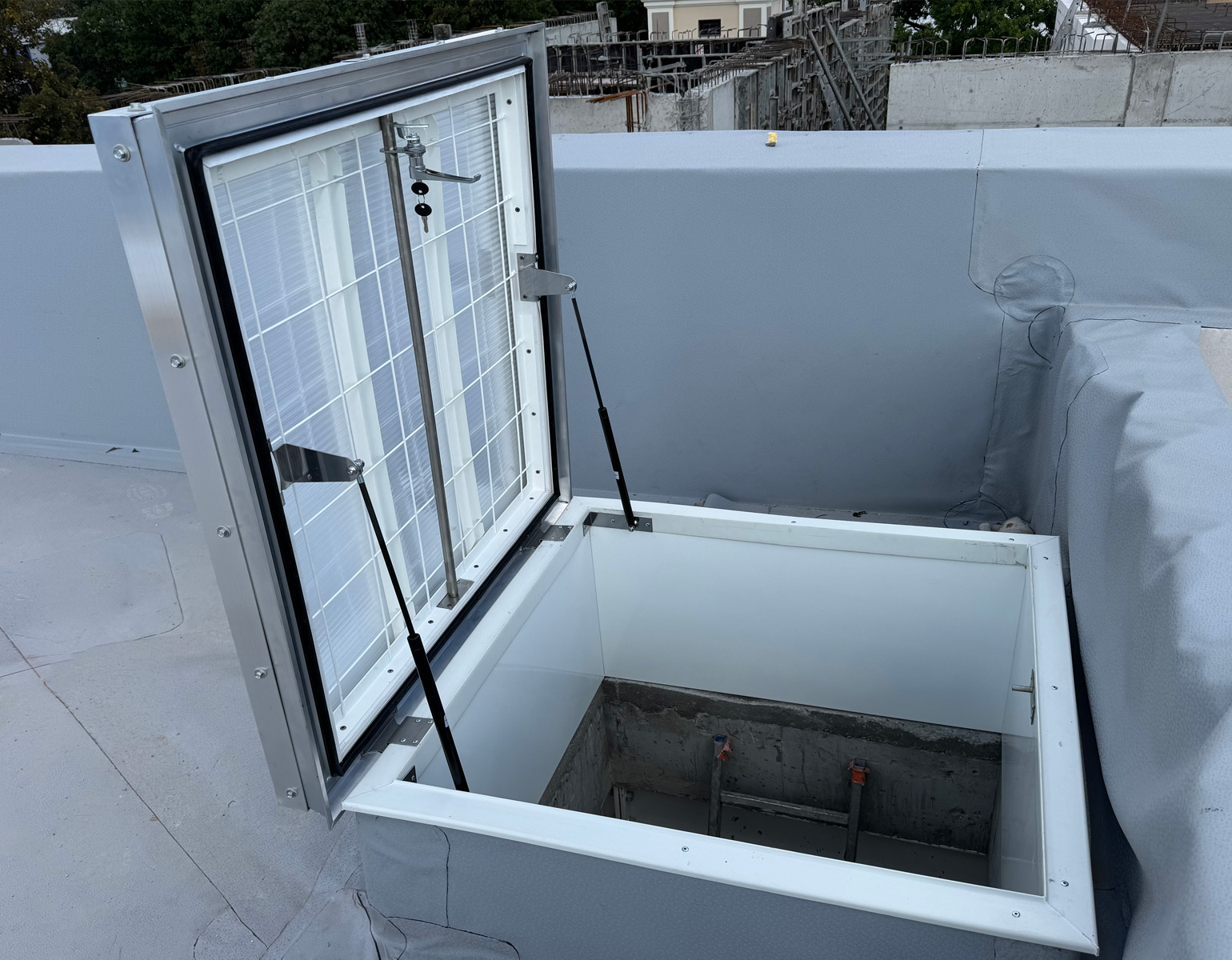
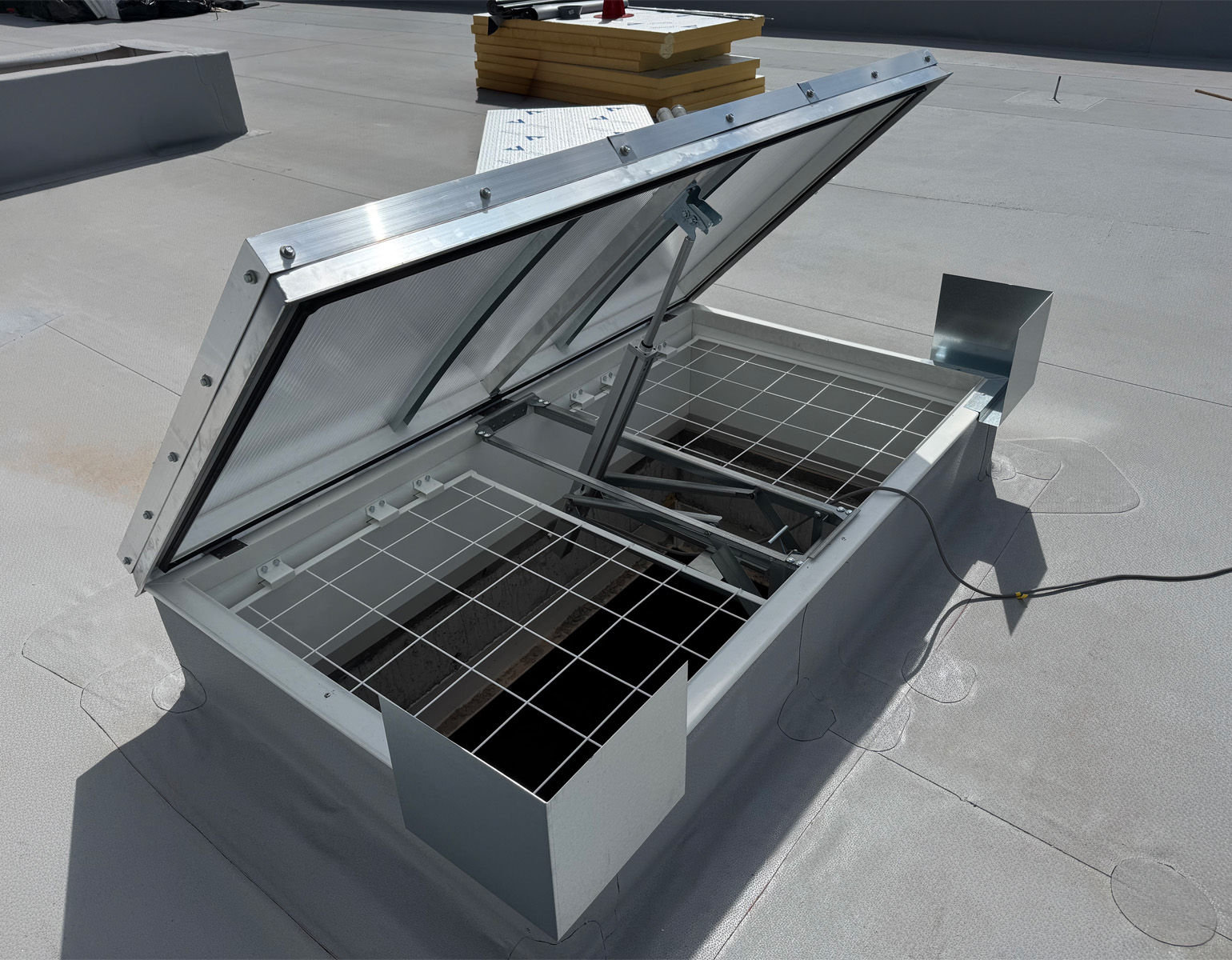
Importantly, the same section of roof can perform several tasks: it can bring daylight into the interior and, once fitted with the appropriate vents, provide ventilation and smoke exhaust in the event of a fire.
Health and Productivity: The Biology of Light
Daylight regulates our biological clock. The retinal ganglion cells respond particularly strongly to blue light with a wavelength of about 480 nm (typical of daylight), suppressing the secretion of melatonin and stimulating the production of cortisol and serotonin. In practice, this means:
- Higher productivity: less eye strain, fewer headaches and greater accuracy.
- Better recovery: employees with access to natural light sleep 37–46 minutes longer on average.
- Contact with the surroundings: continuous rooflights help people keep track of the time of day and changes in the weather, reducing the feeling of isolation in the hall.
Light Quality: Glare and Colour
The EN 12464-1 standard places emphasis on quality parameters that prevent eye fatigue:
- Unified Glare Rating (UGR): in halls it should not exceed 22. Using milky (opal) polycarbonate effectively diffuses the light, eliminating sharp shadows and the risk of dazzling forklift operators.
- Colour rendering (CRI): daylight has a perfect CRI of 100, well above standard LED luminaires (CRI 80). This is crucial in paint shops and at quality control stations, where a CRI above 90 is required.
Energy Efficiency: Intelligent Daylighting Systems
Installing rooflights alone will not deliver the full savings if the lamps keep shining at full power at midday on a sunny day. The key is intelligent control (for example, using the DALI-2 standard). Sensors measure the amount of light coming in through the roof and smoothly dim the luminaires in well-lit zones, while those deeper inside the hall operate at full power. Combined with modern LEDs (150–195 lm/W), this dramatically reduces electricity consumption.
Thermal Balance: Protection Against Overheating
Glazing lets energy through, which affects heating and air-conditioning costs. The summer heat gain from solar radiation is described by the equation:
Q = A × g × I × (1 − SF)
(Where A is the area, I is the intensity of solar radiation and SF is the shading factor.)
- In summer: excessive transparency overheats the hall. Infills with a low g value (for example, Solar Control coatings) are used to reduce heat gains.
- In winter: a higher g value means free passive heat, which relieves the heating system.
- Condensation: to prevent water vapour from condensing and dripping onto machinery, profiles that drain condensate and proper insulation of the rooflight upstand are essential.
Multiwall Polycarbonate or Glass?
In industrial and logistics halls, glass loses out to multiwall polycarbonate on weight and fragility.
| Feature | Glass | Multiwall polycarbonate |
|---|---|---|
| Impact resistance | Medium (risk of breakage) | Very high (resistant to, for example, hail) |
| Weight and installation | Very heavy, requires a strong supporting structure | Light, trouble-free installation |
| Acoustic insulation | Very good | Medium (noisier in rain) |
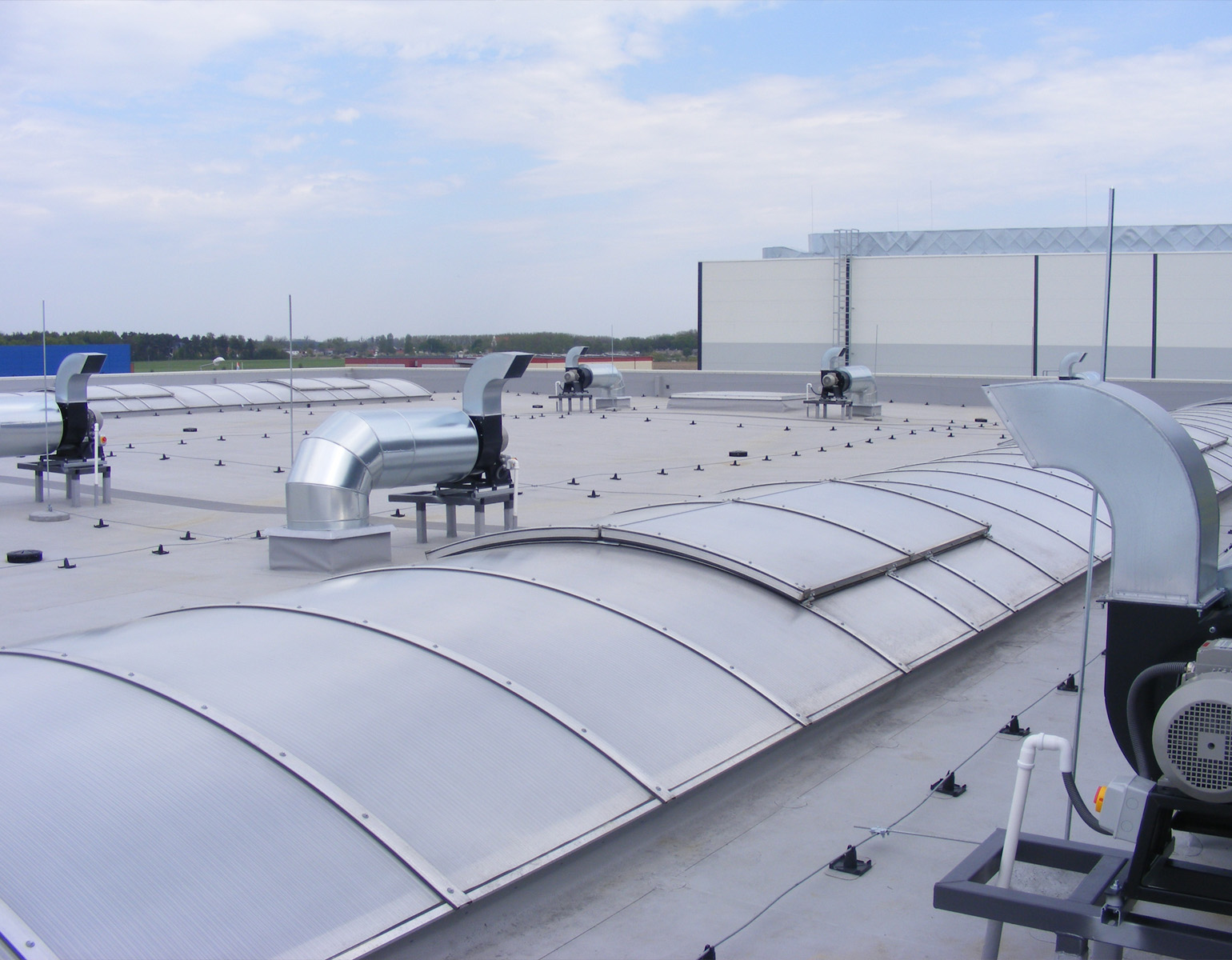
| Forming | Difficult, requires prefabrication | Easy (ideal for, for example, arched continuous rooflights) |
European Standards and Requirements
In Europe, natural lighting design and rooflight selection are based on relevant standards, technical requirements and calculations:
- EN 1873: specifies requirements and test methods for individual rooflights made of plastics, including their relevant performance characteristics.
- EN 14963: specifies requirements and test methods for continuous rooflights of plastics, with or without upstands.
- EN 17037: addresses daylight provision, glare protection and sunlight exposure in buildings.
- EN 12464-1: sets the required illuminance depending on the type of work (for example, 100–200 lx for warehouses, 500 lx for offices).
- Local regulations: for example, regulations in Poland require natural light where people work for more than 4 hours a day (a window-to-floor ratio of at least 1:8) and a maximum U-value of 1.1 W/(m²K) for roof rooflights.
Fire Safety and Photovoltaics
The plastics used on the roof must meet class B_ROOF(t1): they must not allow fire to penetrate into the structure or produce burning droplets. When designing a photovoltaic installation, in turn, it should be consulted with a fire safety expert to maintain safe distances between the panels and the smoke vents and rooflights. Optimisers should be used so that the shadow cast by the rooflights does not reduce the energy yield from the PV.
Yes. Savings of 50–80% are achievable if the installation of rooflights is combined with replacing the luminaires with LEDs and with light-level sensors (daylight harvesting).
Only if they are chosen incorrectly. Using milky polycarbonate or a Solar Control variant (with a low g-value) cuts out excess heat radiation.
No. An ordinary fixed rooflight will not exhaust smoke from the hall, unless it is integrated with a smoke vent module (CE marking to EN 12101-2 is required).
Glass is much heavier, which loads the roof's load-bearing structure, and it is fragile. In production halls, polycarbonate, which is far more resistant to mechanical damage, wins out.